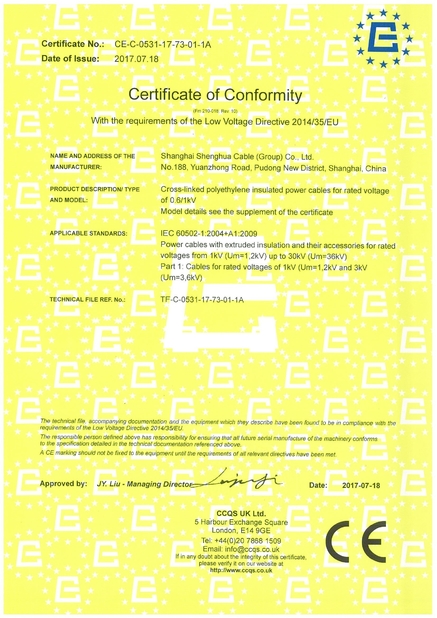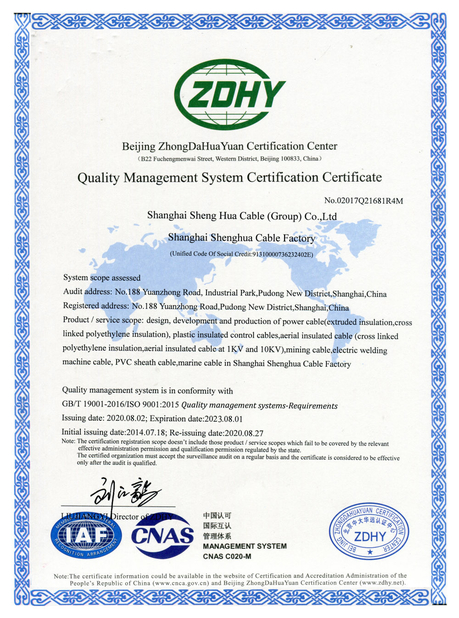
Co. καλωδίων της Σαγκάη Shenghua (ομάδα), ΕΠΕ.
UV resistant cable is the difference between a twenty-five year overhead installation and a five year failure. When a power cable is strung on poles, clipped to a facade or laid in an open cable tray, its sheath absorbs ultraviolet radiation every day, and ordinary PVC or PE compounds crack, chalk and lose elongation within a few summers. This guide explains the polymer chemistry behind UV degradation, the additives that prevent it, the test standards that prove performance, and the specification clauses a buyer should insist on. It also shows how solar gain changes current rating, how to install outdoor cable without undoing the manufacturer protection, and gives six direct answers on carbon black content, xenon arc testing and jacket colour for tropical and desert climates.

Ultraviolet radiation in the 290-400 nm band carries enough photon energy to break the carbon-hydrogen and carbon-carbon bonds of a polyolefin chain. In PVC the first damage appears in the plasticiser system; in polyethylene and XLPE it appears as chain scission followed by cross-linking, which shows up as surface chalking, micro-cracking and a rapid fall in tensile elongation at break. Once micro-cracks reach the insulation or the conductor screen, moisture enters, water trees grow, and the dielectric strength of the cable collapses. UV resistance is therefore a materials engineering problem, not a cosmetic one.
Three mechanisms are used in practice. First, carbon black at a loading of about 2.0 to 2.5 percent by weight absorbs UV energy and dissipates it as heat; a well dispersed black compound is the most cost-effective weathering protection available and is why utility overhead cable is almost always black. Second, hindered amine light stabilisers and UV absorbers interrupt the radical chain reaction that follows photon absorption, and are essential in coloured or light-grey compounds where carbon black cannot be used. Third, the polymer base itself matters: XLPE and PE compounds with a high molecular weight and a controlled antioxidant package resist oxidation far better than general purpose PVC, and a properly cross-linked insulation will not melt and flow when a black sheath reaches 70 degrees Celsius in direct sun.
| Element | Function | Typical specification |
|---|---|---|
| Carbon black | UV absorption and screening | 2.0-2.5 percent, well dispersed |
| HALS / UV absorber | Radical scavenging | 0.3-0.8 percent in coloured compounds |
| Antioxidant | Thermal-oxidative stability | Phenolic plus phosphite system |
| Base polymer | Inherent weathering resistance | XLPE, PE, or UV-grade PVC |
| Test reference | Proof of performance | ISO 4892-2, ASTM G155, IEC 60811 |
The word stabilised is often used loosely. A UV stabilised PVC compound is not the same as a UV resistant cable design: the first describes an additive package, the second describes a tested construction with a defined sheath thickness, a defined carbon black dispersion and a defined retention of mechanical properties after accelerated ageing. Buyers should ask for the second.
The economics of UV failure are brutal because the damage is invisible until it is structural. A sheath that has chalked and lost 50 percent of its elongation still looks intact from the ground; the same sheath will crack at the point of support during the next storm, water will enter the assembly, and the fault will appear two spans away from the visible crack. Maintenance crews then replace a whole section rather than a component, and the utility absorbs both the material cost and the outage cost.
1. Surface temperature and current derating. A black cable in direct sun can run 15 to 25 degrees Celsius above ambient air temperature. In a 45 degree Celsius desert climate the sheath surface may exceed 70 degrees Celsius, and the conductor inside runs hotter still. If the installation was designed with an ambient of 30 degrees Celsius, the cable is thermally overloaded long before it reaches its nominal current. UV resistant constructions must therefore be paired with a solar gain correction factor in the current rating calculation, not treated as a simple material upgrade.
2. Mechanical property loss. Standards such as IEC 60811-501 evaluate tensile strength and elongation at break before and after ageing. An unstabilised PVC sheath can lose more than half of its elongation after a few hundred hours of xenon arc exposure, while a properly formulated UV resistant compound typically retains above 75 percent. That retained elongation is exactly what allows the cable to survive thermal cycling, wind vibration and installation handling for decades.
3. Colour fading and identification failure. Coloured sheaths are used for phase identification and for earth conductors. Without HALS and UV absorbers, red, blue and green-yellow compounds fade, and the loss of identification becomes a safety issue during maintenance. Green-yellow earth cable in particular must remain legible for the life of the installation, which is why UV stabilised compounds are specified rather than standard colour masterbatch.
4. Total cost of ownership. A UV resistant cable may cost a few percent more per metre than a standard outdoor cable. Against that premium, a single premature replacement on a pole line, including access equipment and labour, typically costs many times the price difference of the whole span. For projects in the Middle East, Africa, South Asia, Latin America and Oceania, UV resistance is not an optional upgrade; it is the baseline specification that determines whether the warranty is realistic.
Start with the exposure class. A cable installed in a covered duct or indoors behind a facade sees almost no direct radiation and needs no special compound. A cable clipped to an outside wall, laid in an open tray on a roof, or strung overhead is fully exposed and must be specified as UV resistant. A cable partially buried and partially exposed must be treated as exposed for its whole length, because the transition point is where water and radiation combine.
Then write the requirement in measurable terms. Ask for the sheath compound to contain 2.0 to 2.5 percent well dispersed carbon black where black is acceptable, or an equivalent HALS system where colour is required. Ask for a xenon arc or fluorescent UV test report to ISO 4892-2 or ASTM G155 with a stated exposure time, and for tensile and elongation retention figures to IEC 60811-501 after ageing. Ask for the insulation and sheath to be tested together as a construction, not as separate granules. A supplier who cannot produce these documents is selling hope rather than a specification.
Installation decides whether the protection survives. Cable should be stored under cover and never left on a drum in the yard for months with the outer laps exposed, because the outermost layer absorbs the dose intended for the whole design life. When pulling overhead, use suspension clamps with elastomer inserts so the sheath is not abraded at the support, and avoid sharp edges on trays and conduit entries. Where cables are tied to a messenger, use UV stabilised ties; ordinary nylon ties fail by embrittlement in two or three seasons and leave the cable fretting against the support. Where the cable enters a building, seal the penetration and form a drip loop so water does not track along the sheath into the wall.
Finally, correct the current rating. Apply an ambient temperature factor for the actual site, then add the solar gain allowance for exposed installation, then apply the grouping factor for trays. For a 4x35 mm2 0.6/1 kV cable rated 125 A in free air at 30 degrees Celsius, a 45 degree ambient alone reduces the figure to roughly 105 A, and an additional solar correction for a black exposed sheath can bring it to about 90 A. Sizing the cable on the catalogue figure without these corrections is the single most common design error in hot climates.
| Exposure case | Recommended construction | Extra requirement |
|---|---|---|
| Indoor or buried duct | Standard PVC or XLPE | None |
| Outdoor wall or facade | UV stabilised PVC or XLPE sheath | Black compound or HALS |
| Open cable tray on roof | UV resistant, black preferred | Solar gain derating |
| Overhead on poles | ABC or UV resistant sheathed cable | UV stabilised ties and clamps |
| Coastal plus sun | UV resistant plus corrosion resistant | Sealed ends, tinned copper option |
Current production covers these cases directly. The UV resistant PVC insulated power cable 0.6/1 kV 4x35mm2 for aerial overhead use is the standard outdoor feeder. The VGV 3x4mm2 UV resistant PVC insulated cable to IEC 60502 suits overhead industrial circuits, and the ABC 4x35mm2 UV stabilised aerial bundled cable is the bundled option for rural distribution. For lighting circuits the NYM 3x2.5mm2 UV resistant cable 450/750 V is commonly used, while the NYY 4x70mm2 anti UV cable for direct burial and sunlight exposure covers the mixed buried and exposed route. Larger overhead feeders can use the UV resistant aerial 3x185mm2 aluminium XLPE cable, and solar plants frequently specify the PV1-F solar cable 1x6mm2 with tinned copper conductor because the DC side is permanently exposed.
Documentation is where most outdoor specifications quietly fail. A cable can be manufactured with a correct compound and still arrive on site without traceability, because the drum label names the product but not the batch, and the test certificate covers a different production run. Buyers should require a drum label with product code, size, length, batch and manufacturing date, a certificate of conformity that references the same batch, and a weathering test report that states the exposure hours rather than only the standard. It is also worth requiring a retained sample of about one metre per batch, sealed and labelled, so that any future dispute about compound quality can be settled by laboratory comparison instead of by argument.
Think in terms of the whole exposed assembly, not only the sheath. Metallic screens, armours and glands in a coastal or industrial atmosphere corrode faster when they are warm and wet, and a UV degraded sheath lets water reach them earlier. Where the site combines strong sun with salt spray or sulphur dioxide, specify a UV stabilised oversheath plus a sealed end cap, use tinned copper where a screen or conductor is exposed, and inspect the transitions at every pole and building entry during routine maintenance. A two-minute visual check for chalking, colour change and surface cracking at the support points will catch the early stage of weathering long before an insulation resistance test shows a problem, and that check is the cheapest reliability programme available to any utility.
Ask for the sheath compound data sheet and an accelerated weathering test report to ISO 4892-2 or ASTM G155, including tensile and elongation retention. Marketing words alone are not evidence.
Black is preferred because 2.0-2.5 percent carbon black screens UV efficiently. Coloured cables can perform equally well but need HALS and UV absorbers, and the test report must confirm it.
UV resistance itself does not, but the exposed installation that requires it does. Solar gain and higher ambient temperature reduce the permissible current, so derating factors must be applied.
Painting is not a substitute for a stabilised compound. Solvent in paint can attack PVC, and cracks form underneath the film, trapping moisture against the sheath.
With a properly stabilised sheath and correct installation, a design life of 20-25 years is realistic. Unstabilised PVC in strong sun can fail within 3-5 years.
Yes. Standard nylon ties embrittle and snap within a few seasons. Specify UV stabilised ties, or use metallic or stainless steel ties with protective edging.
UV resistance is a compound formulation and a tested construction, not a label. Specify carbon black content or HALS loading, demand accelerated weathering data, correct the current rating for solar gain, and protect the sheath during installation with proper clamps and UV stabilised ties. Done properly, an outdoor cable gives 20-25 years of service instead of a premature replacement cycle. Shanghai Shenghua Cable Group supplies UV resistant PVC, XLPE and solar cable constructions from 0.6/1 kV service cable to 1500 V DC photovoltaic wire, with test reports to ISO 4892-2 and IEC 60811 on request. Share your site latitude, ambient temperature and installation method through our contact page, and our engineers will propose a UV resistant construction with a corrected current rating and a drum plan for your project.